The economic and social dimension of the “Eastern Partnership” domestic and foreign experts discussed in Kiev
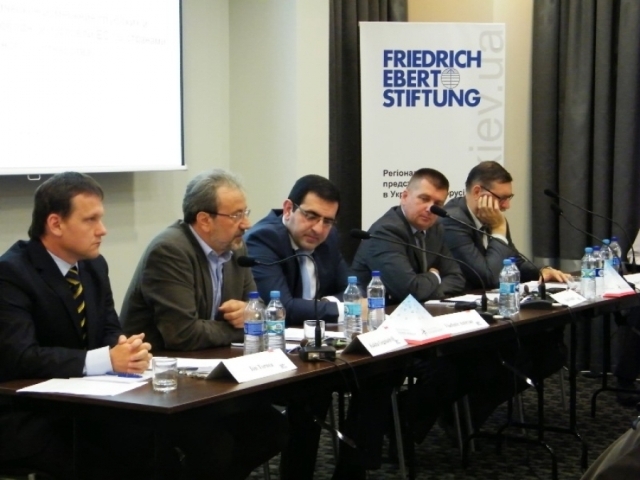
Experts from the Eastern Partnership countries (JV), members of the National Civil Society of the JV Forum, as well as representatives of Ukrainian public and government organizations have joined the discussion of the benefits and challenges of European integration within the International Conference “Socio-Economic Dimension of the Full and Comprehensive EU. Захід відбувся 3 вересня 2013 року у м. Києві за організаційного сприяння Другої Робочої групи Форуму громадянського суспільства «Східного партнерства» спільно з Поліським фондом міжнародних та регіональних досліджень у партнерстві з Регіональним Представництвом Фонду імені Фрідріха Еберта в Україні і Білорусі.
The Eastern Partnership region is a relatively new formation on the world’s geopolitical map, but ambitious in your desire for European integration. At the same time, the Euro -optimists of these countries in their preferences are more focused on interests rather than the values offered by the European community. In particular, it is about processes that accompany the need to form a free trade area (FTA). There is no need to expect an instant improvement from the signing of the Association Agreement with the EU or the entry of the JV countries into a common European home. The Euronovian will be waiting for both privileges and social and economic challenges. At the same time, citizens have the desire to live better, but they treat the changes. In view of this, within the framework of the International Conference, experts have developed proposals for possible areas of cooperation with the EU, as well as between the JV countries to overcome the potential social and economic challenges of European integration, reduce socio-economic disparities and ensure stability in the region. Three plenary sessions and a discussion club – the conference participants worked in this format.
During the first panel, they performed Igor Burakovsky (Chairman of the Board of the Institute for Economic Research and Political Consultations, Ukraine), Vladimir Amirian (Head of the Armenian Chamber of Commerce and Industry), Kahaber Gogolashvili (Director of the European Studies Center of European Studies Studies Program), Ion Thornea (expert at the Institute of Development and Social Initiatives Viitorul, Moldova).
The speakers have made a forecast for the new prospects of their countries from the liberalization of trade with the EU, as well as distinguished sectors of national economies, which are most sensitive to new conditions of functioning. An important factor in effective cooperation, according to Mr. Burakovsky, there is a complete implementation of the FTA, not the situational implementation of certain norms. Reforming the institutional organization of public authorities is an urgent issue for the Republic of Moldova, sure Ion Thornea. Experts also agreed that the state authorities of individual countries of the JV are characterized by the separation of internal issues from external, which is fundamentally wrong.
Further issues of EU interest in creating FTA with Eastern Partnership countries during a web conference hitWojciech Kononchuk (Head of the Department of Ukraine, Belarus and Moldova of the Center for Eastern Research, Poland). The expert believes that Brussels is interested in the economic integration of JV countries no less than the countries of the region themselves. And it is not only about democratic processes in neighboring countries, but also about the economic benefit of the European community.
An important aspect of the FTA formation process is the social component. The labor market, migration, education and health care are the areas of social dimension of the FTA to which experts were extrapolated during the second panel. Speakers from the Ukrainian side have made here Irina Petrov (Professor of Kyiv National Economic University), Victor Chiahikov (Professor of Kyiv National Economic University), Kateryna Nikonyuk (Kyiv National Economic University), Alexei Poznyak(Institute of Demography and Social Research of Ukraine). The speakers described the current issues of these areas, as well as outlined possible areas of EU cooperation with the JV countries in the context of ensuring sustainable social development.
According to the words Mrs. Petrova, employment level in Ukraine is quite acceptable. However, the issue of modernization of jobs, including the creation of “green” places, is an important issue in the context of adapting the labor market to European standards.
Subsequently, a web conference with coordinators and activists of 2 working groups of national platforms of the Eastern Partnership Civil Society Forum. Yevgeny Roshkovan (Moldova), Karen Chilengian (Armenia), Sabit Bagirov (Azerbaijan), Yegor Klimovich (Belarus) and Givi Kocharadze (Georgia)They expressed their thoughts on the social challenges of European integration, which can potentially threaten the countries they represent on the FGS. In each country to a varying degree, but there are certain expectations of changes in the field of education, medicine, labor migration.
Zia Alily (expert of the Center for Economic and Social Development, Azerbaijan) and Veronica silence(Director of the Center for Economic Research of the Institute for Economic Research and Political Consultations, Ukraine) spoke within the third plenary session. The preference experts for the JV countries, which they offer the FTA and the Customs Union, spoke and compared. As a conclusion, it can be said that along with the negative expectations of the formation of FTA positive long -term results, much more, in which the Customs Union loses significantly.
Russian political expert Andriy OkaraSpeaking during a web conference commented on Russia’s attitude to European economic integration projects in the Eastern Partnership region. “Obviously, Russia is very painfully experiencing the intentions of Ukraine to sign the Association Agreement with the EU. After all, “imperialist” pro -Russian projects are impossible without participating in Ukraine, ” – said Mr. Okara.
The event ended with a discussion club on ways of deepening European integration, which was attended by all invited experts. In the course of active discussion, there was an attempt to answer the question of what to take into account in the context of social challenges in the implementation of European Ingtegration Steps, what a role in this process of civil society. The main theses of the discussions will be summarized in the positional document of the 2 working group of the forum of public society, which will be announced at the Civil Society Forum in early October in Chisinau.