Elections in Chernihiv region: numbers, facts
On October 8, another important stage of the election campaign for the election of deputies of the Verkhovna Rada of the Autonomous Republic of Crimea, local councils and village, settlement, city mayors ended.
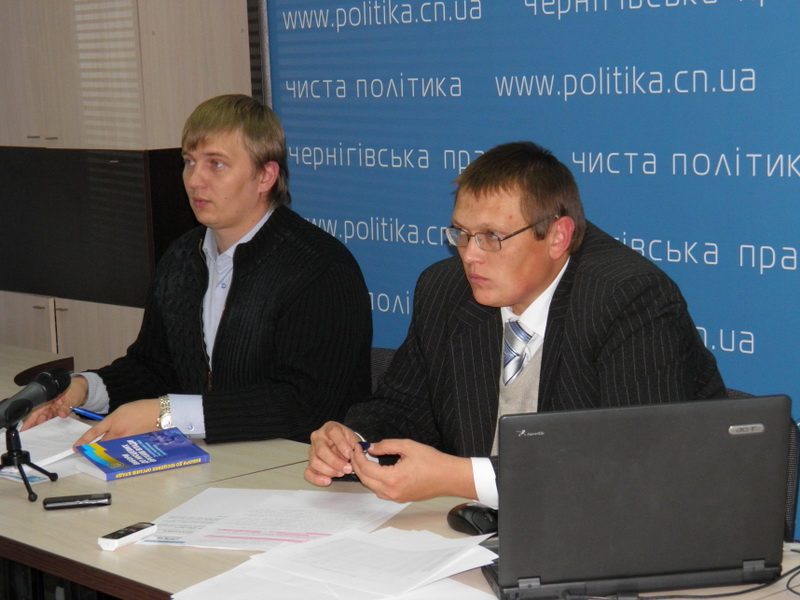
According to the monitoring of this stage of local elections, a press conference “Elections in Chernihiv: figures and facts” was conducted in the expert club pure policy. Project coordinators in the Chernihiv region spoke about the features of the election campaign in the region.
In general, in the region, the process of nomination of candidates for deputies took place within the limits of the current legislation, and observers of GM OPORA did not record mass cases of violations of this procedure. In most cases, party conferences were in the open mode, with the invitation of TEC members and journalists. The facts of refusal to register the lists are not recorded.
 The main political figures in the areas of elected positions have intensified their campaign campaigns this week. Mainly electoral propaganda is carried out through the placement of information on outdoor advertising media (billboards and city-lights), the work of agitation tents, the distribution of various printed products (brochures, newspapers, etc.), holding candidates with voters, press conferences, conducting concerts. The reception of full -time voters about the candidate’s work with the help of the main local media is also used.
Since the beginning of the election campaign, the most active agitation work of the party has been carried out in the regional center. This week, observers have recorded an increase in agitation activity not only in cities of regional importance, alleys in district centers and villages.
The activity of the Central Election Commission is still limited to the approval of various explanations, which would detail certain norms of electoral law and making decisions on amendments to the personnel composition of the TEC.
The decision on changes in the staff of the commissions significantly influence the distribution of places in territorial election commissions, and especially the division of management positions in TEC. This further increases the disproportion of the number of positions in commissions between different parties and can further be used as an argument to confirm the dishonesty and opacity of the electoral process. Although political forces whose representatives refuse to work in commissions are guilty of such a situation because of an irresponsible approach to recruitment.
As a result of changes in the TEC leadership in Chernihiv region, only a party of regions has increased its representation among the heads, deputies and secretaries of commissions, without losing any “bayonet”.
The territorial election commissions themselves in general have time to comply with all the procedures necessary under the legislation. At the same time, TECs today are lack of funding, have problems due to lack of methodological and explanatory information and short timing of the election campaign. The number of parties involved in local elections in different areas is very different. It is known that in Chernihiv region there are 24 political parties in elections to the regional council, 30. They beat records by the number of parties who want to be presented in the city councils of the regional centers of Khmelnitsky (58) and Lviv (51). The least willing to get to the Dnipropetrovsk City Council (17).
As for the number of candidates for mayors, the leader is again Lviv (21), and only 4 candidates seek the head of Rivne. It is known that 10 candidates claim the post of Chernihiv mayor.
The councils of all administrative and territorial units of Chernihiv region were covered by 5 parties: the Party of Regions, the Batkivshchyna, the Communist Party of Ukraine, the Strong Ukraine and the Socialist Party of Ukraine. In the districts of the region, the largest number of parties is registered in Novgorod-Siverskaya (17), Kozelets (15) and Korop (15) district TECs.
With regard to candidates for the positions of city/settlement heads of district centers and cities of regional importance, the maximum number, ahead of the regional center, has the city of Mena, where 12 candidates compete for the right to lead the city. The chair of the mayor of Novgorod-Siversky is outlined by 10 applicants. But those who want to become the head of Koryukivka, as well as carp, only 2.
However, it is clear that no matter how many parties and candidates have run, the results of voting and the distribution of seats in councils will depend primarily on the level of popularity of parties and candidates, as well as on how honestly and transparent the stage of vote count will pass.
At the end of the event, experts of GM Opora were emphasized at certain problematic points that could adversely affect the election results and create potential conditions for abuse. First, it is a decentralized printing of ballots and low financial support for this process. Secondly, it is granted the right to the territorial election commissions with the law to cancel the decision on registration of candidates for deputies and a candidate for the post of village, settlement, mayor not later than 22 hours of the day, which precedes the Voting Day. Considering the party composition of the commissions and their management, this rule can become a potential tool for the election of the “inconvenient” candidate at any time the course of this election.
Currently, in Chernihiv there is a situation where one of the candidates for the post of mayor from “Strong Ukraine” Mykola Mikhalevich received two warnings from the city TEC on complaints filed with the commission by a lawyer of another candidate, the current mayor Alexander Sokolov. The grounds for making the warnings that were given in complaints are not interpreted unambiguously.
In this context, it should be noted that O. Sokolov was nominated by a candidate for the post of mayor of the Party of Regions. T. Poluyashchenko is the chairman of the city territorial election commission, which also represents the Party of Regions.
Throughout the election campaign, the OPORA GM will promptly inform media representatives of all detection of violations that will record public observers.
Source: Romanenko Eugene,
Polissya Fund of International and Regional Research