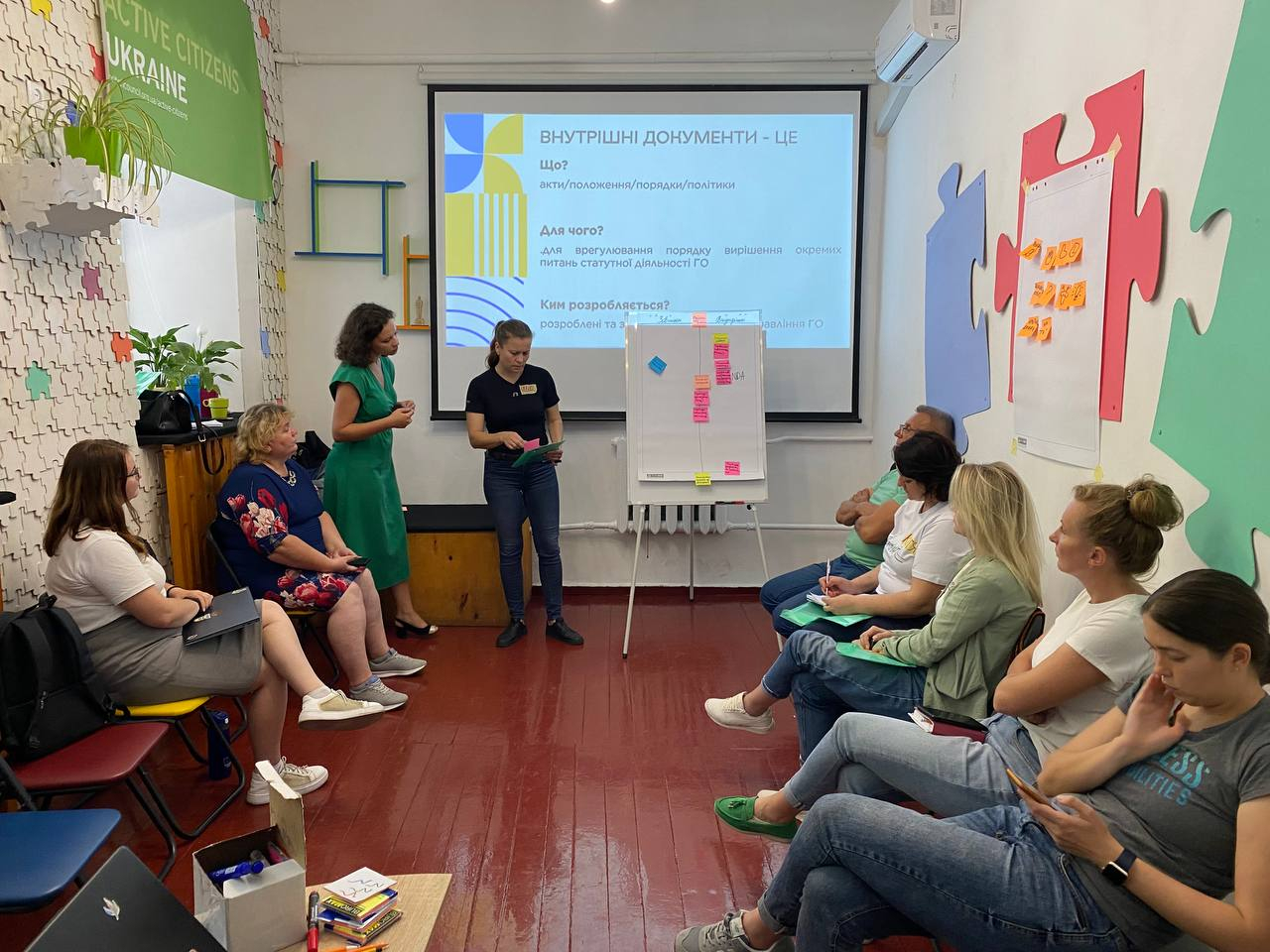
The “Ohirok” hub hosted a training session on “Policies, tools, and procedures for effective management of non-governmental organizations and initiatives”
The effective operation of a civil society organization is impossible without a set of documents that clearly define its work. The sixth training session, “Policies, Tools, and Procedures for Effective Management of Non-Governmental Organizations and Initiatives,” was part of the HAB training program for CSOs and initiative groups, “OHIROK,” which is being implemented at the Nizhyn City Youth Center. and with the support of the Polissia Foundation for International and Regional Studies within the framework of the EU program “Strong Regions – Special Support Program for Ukraine” was about just that.
On the first day, participants and trainers discussed the legal aspects of NGO activities, as the activities of such unique instruments as non-governmental organizations are supported by the current legislation of Ukraine. Another important topic on the first day was the review of the organization’s founding and statutory documents, which are the necessary documents that provide the legal basis for the activities of a public organization and define its goals, mission, vision, and areas of activity.
Training course “Policies, tools, and procedures for effective management of non-governmental organizations and initiatives” (as part of the capacity development training program for civil society organizations in the Chernihiv region of the Polissya Foundation for International and Regional Studies project “OHIROK Civil Society Organizations Capacity Hub”) was held as part of the EU project “Strong Regions – Special Support Program for Ukraine” co-financed by the European Union (EU) and the German Federal Ministry for Economic Cooperation and Development (BMZ) and implemented by Deutsche Gesellschaft für Internationale Zusammenarbeit (GIZ) GmbH.
The content of this publication regarding the specified activities, however, is the sole responsibility of the Polissia Foundation for International and Regional Studies. The opinions, conclusions, or recommendations expressed herein are those of the authors or compilers of the publication and do not necessarily reflect the views of the European Union, the German Federal Ministry for Economic Cooperation and Development (BMZ), or the Deutsche Gesellschaft für Internationale Zusammenarbeit (GIZ).


