“Summit Ukraine – EU: What will save the European integration of Ukraine?” – The opinions of experts
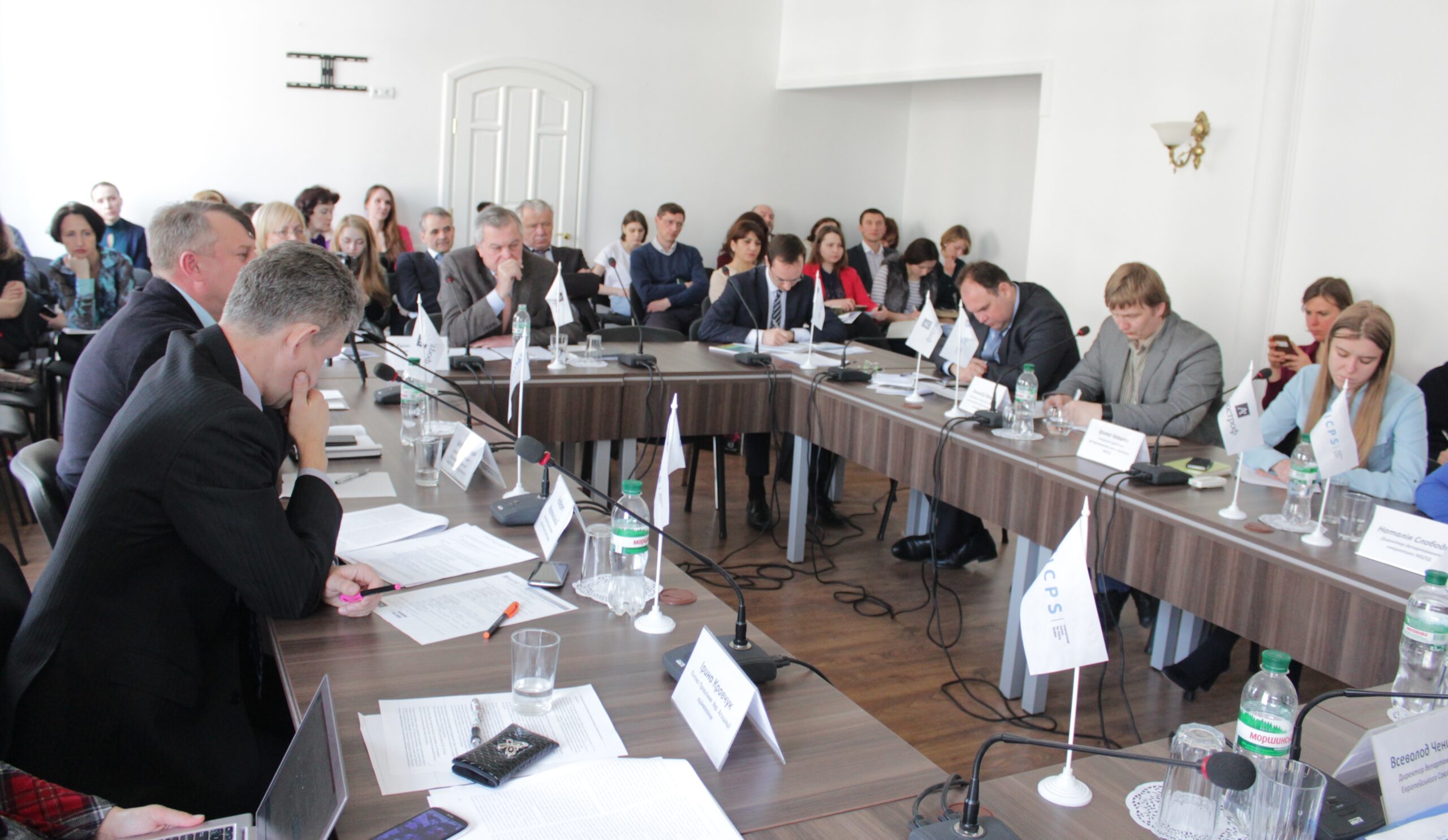
On the eve of the EU-Ukraine Summit, which will take place on April 27 with the participation of EU leaders and President of Ukraine P. Poroshenko, the International Center for Promising Studies held a round table, which discussed the current state and prospects of bilateral relations between Ukraine and the EU. The event was attended by the President of the Polissya Foundation Gennady Maxak.
Starting the event, Vasyl Filipchuk, the chairman of the ICPD board, noted that the window of opportunity for Ukraine after the Maidan is not eternal. Therefore, it is important to immediately intensify work on reforms, including for the sake of European integration. So far, according to the expert, there are no reason to believe that Ukraine will receive a visa -free regime with the EU countries at the summit.
In turn, Gennady Maxak spoke about the Eastern partnership and the importance of the multilateral format of cooperation for Ukraine.
The Director of the EU Department of the Ministry of Foreign Affairs of Ukraine Vsevolod Czentsov noted that the current summit will be held in an unprecedented and specific atmosphere of Russian aggression and economic crisis in Ukraine. The security context is new to relations with the European Union. Both Russia and the EU are now a common factor in Russia – the latter shakes both Ukraine and the European Union. And a Ukrainian request for the mission of European peacekeepers is not something extraordinary, which does not fit into the format of EU activities.
The diplomat also noted that the EU is not ready to “invest” in Ukraine at the point of view of financial support, as it was done in relation to Poland.
Among the latest achievements of the Ukrainian side in the issue of European integration, V. Centsov noted participation in the program “Horizon – 2020”, approximation to participation in the program “Creative Europe”, adoption of the law on the gas market (which is the implementation of the third energy package), etc. The EU-Ukraine Summit sees the diplomat as “the opportunity to inventory in the context of reforms-what we still have to do.”
Vadim Truhan stressed that there are no alternatives to European integration for Ukraine. But there will be no success in this direction until domestic politicians think only in narrow and political categories.
Senior Economist of ICPD Vasyl Povoroznik focused on the readiness of Ukraine for the introduction of the FTA in 2016. In preparation for the full implementation of the FTA, the reform of the public procurement system is the first priority. The key task in this area is to increase the transparency of domestic purchases and to open access to them for suppliers and service providers with the EU. This reform began in 2014 with the adoption of the Law of Ukraine “On Public Procurement”, however, based on statistics, this law did not cause significant intensification of public procurement.
In the field of technical regulation, impetus to the transition to European standards and fulfillment of all obligations of Ukraine, in particular, in the industrial sphere should be implemented by the implementation of the Law of Ukraine “On Technical Regulations and Conformity Assessment”, adopted in early 2015. Bringing compulsory technical regulations in our country will stimulate the unobstructed circulation of products between Ukraine and the EU.
Among the most sensitive sectoral priorities are reforming the energy sector. The key purpose of reforms of the National Energy Sector is to achieve three tasks: strengthening the energy efficiency of the national economy at the expense of economic methods (the refusal of the state to subsidize enterprises and the population); diversification of energy supplies, build -up and comprehensive support of the national energy producer; Liberalization of the energy market and creation of a favorable investment climate through the global reform of Naftogaz of Ukraine.
Natalia Slobodyan, Director of the ICPD Energy Policy Department.
In the context of the liberalization of the energy market, the Law of Ukraine “On the Market of Natural Gas” was adopted. According to this Law, the principles of the third energy package of the EU on demonopolization in the gas market and the separation of types of activities of companies in production, transportation and distribution are introduced. However, the legislative not to settle the activity of the regulator, which, according to the said act, is endowed with exclusive powers, does not allow to determine the specific terms and mechanisms of implementation of its provisions. In addition, the delay in the reform of Naftogaz, – transferring the date of reorganization from 2015 to 2017 as part of the IMF cooperation program (EFF) – will adversely affect the liquidity of our country’s energy assets and hammer the process of attracting foreign investments for the technical renewal of gas and storage.
Regarding the issues of visa -free regime, Senior Irina Ivashko’s senior analyst Irina Ivashko reported that despite its priority, Ukraine failed to fulfill the necessary technical requirements and has no chance of obtaining a positive decision to introduce a visa -free regime with the European Union by the end of 2015, although it seemed quite a year ago.
European partners are not openly satisfied with the too slow implementation of reforms in Ukraine and the lack of real results in the fight against corruption – one of the key requirements of VDVL. According to the latest report of the Council of Europe Groups against Corruption (Greco) on Ukraine’s compliance with corruption recommendations, Greco experts have stated that 16 of the 25 recommendations provided by Ukraine were satisfactory or resolved in a satisfactory way.
Representatives of the European Integration Group of the RPR Robert Khorolsky and Irina Kravchuk in their speeches focused on the role of civil society in monitoring the implementation of the Association Agreement. According to the agreement, civil society has the right and must be involved in such monitoring.
Representatives of the expert environment should combine efforts in making specific steps in order to achieve the goals of the Association Agreement.
The same opinion was supported by the co -chair of the platform of civil society Ukraine – Esoleksandr Sushko.
In general, according to the participants of the discussion, during the nearest summit Ukraine – the EU Ukrainian leadership has at least:
– to propose an EU a new concept of development of the European continent that would make it possible a conflict -free and mutually beneficial coexistence of European countries;
– to use the time that remains before the introduction of the FTA, to comply with technical standards to EU requirements, improve the readiness of Ukrainian companies to use new conditions in trade with the EU, to develop a strategy, as well as to develop a balanced policy in negotiations with Russia;
– to ensure the consolidation of a specific date for the introduction of a visa -free regime with the EU, indicating the list of clear criteria to achieve this goal;
– provide a schedule of implementation of the EU Third Energy Package, in particular the abolition of energy monopolies;
– to outline the steps in order to strengthen the institutional support of the coordination body for the implementation of the Association Agreement, to establish a state body with sufficient powers and personnel potential at the Government Office at the Government Office at the Government of the Government of Ukraine.
According to the site materials International Center for Perspective Research