
The administrative service system requires improvement and electronization – the conclusion of experts of the Association of Regional Analytical Centers
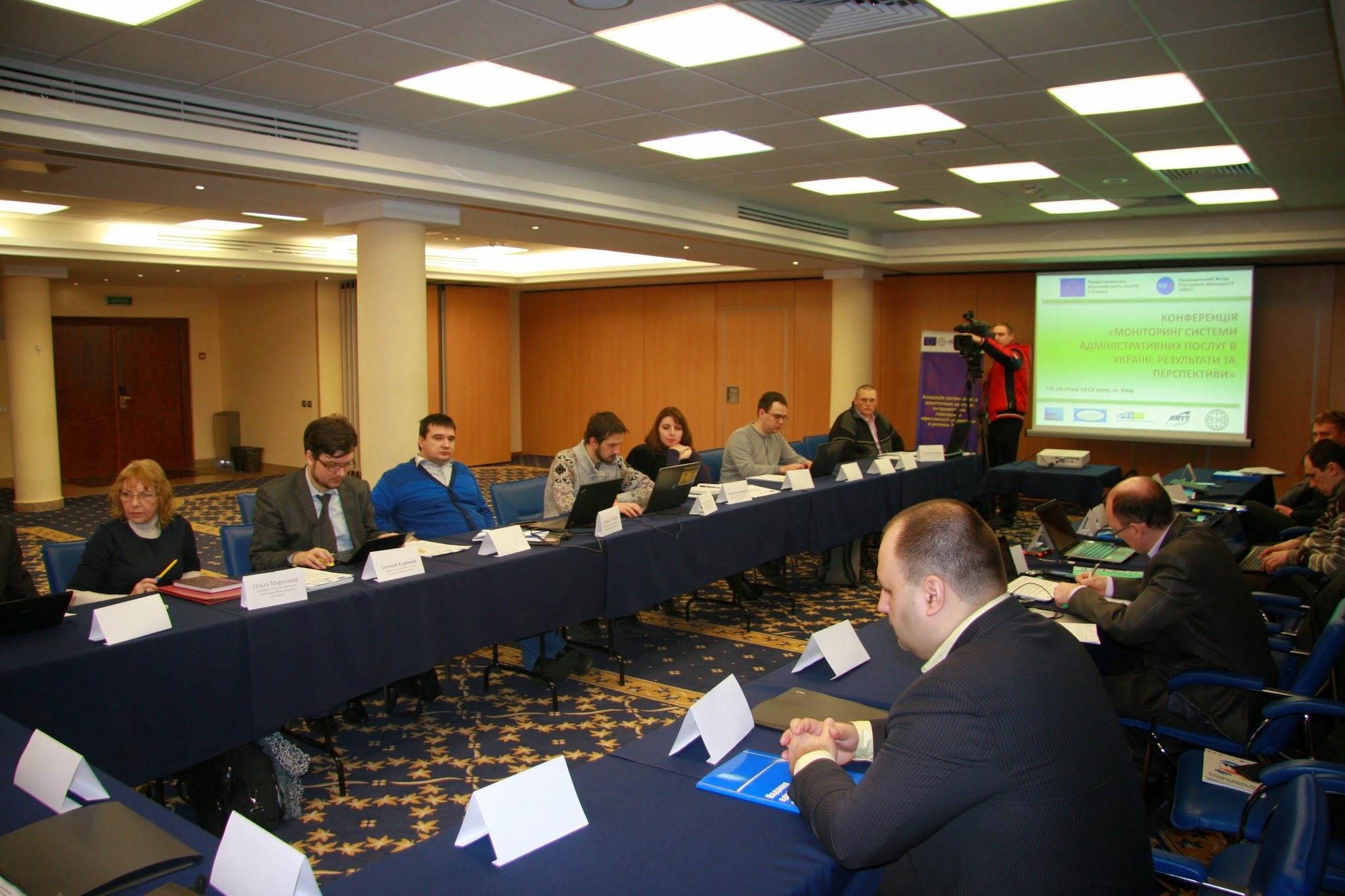
The Conference “Monitoring the Administrative Services System in Ukraine: Results and Prospects” was the final measure of the monitoring project of the Polissya Fund of International and Regional Research. The event took place on January 23-24, 2015 at the Rus Accod Hotel and was conducted by the Association of Regional Analytical Centers and the Polissya Fund as part of the project “Association of Regional Analytical Centers: A tool for improving management efficiency in the regions of Ukraine” with the support of the European Union and National Endowment.
The presentation took place during the conferenceThe results of a comprehensive study of the work of administrative services centers (CNAP)“Provision of Administrative Services in Ukraine: View from Regions”, executed by the Association of Regional Analytical Centers in 14 Regions of Ukraine. The participants of the event, including not only representatives of the Association but also the Center for Political and Legal Reforms and the Kiev CNAP-U, discussed the recommendations developed in the framework of the project to improve the quality of the administrative services system in Ukraine and accumulated them into the resolution.
According to analysts, each of the studied cities has its advantages and disadvantages in the organization of work and directly functioning of CNAP. For example, a characteristic problem is that the cost of public services is not unified, therefore pricing in this context raises many questions.
Odessa researchers have agreed that the most acute is the problem of technical arrangement of the center and the lack of qualification of its employees. This, in turn, according to expert Yuri Melnik, is caused by the absence of a holistic state policy in providing administrative services and a lack of full understanding by the management of the CNAP of the principle of “separation” of the provider of administrative services from their recipient. Despite all the officials are open to dialogue and ready to eliminate the shortcomings.
The CNAP-U Educational and Methodological Center is an urgent need for Cherkasy city authorities. Analysts also revealed a sensitive issue in the plane of the ratio of services provided to the authorities and citizens. Thus, 176 types of services are provided in Cherkasy, and the total number of visitors is 65 thousand people a year. But the lion’s share of recipients of services are representatives of local authorities. Also, despite the successful infrastructure solutions and comfortable conditions for staying in the center, there is now no official website of this structure.
In this area, the city of Vinnitsa also has shortcomings in its management decisions, according to researchers. The incompleteness of the information posted on the stands, the mode of operation and wardrobe-the problematic issues that arise on the background of the successfully optimized work of all CNAPs in the city. The uniqueness of the Vinnytsia Center is the availability of a system of evaluating the efficiency of the CNAP employee in online mode and the existence of their own “Code of Administrative Services”, which defines the standards of quality of work of the Center.
The city of Nikolaev traces European trends on customer service. Yes, in practice, the administrator independently completes the applicant’s documents. However, in the CNAP for a long time did not work surveillance cameras – they, according to the Nikolaev expert, had to be installed at their own expense. In addition, there is no (not intended) management of the center in the CNAP-I.
The problems of the KNAP-Yves of Kharkiv are similar to those already mentioned. However, Kharkiv managers during the period under study were listened to the advice of experts. Currently, the learning and advanced training process is organized here not only for administrators but also by officials.
The issue of overtime organization of work and lack of time to improve their skills is not a unique, but typical problem for the city of Lutsk. Despite the best experience in the question of the functioning of the CNAP-U, negative tendencies have been identified. Yes, the official website of the Center has not yet been created. The management promises to listen to the advice of representatives of the Association of Regional Analytical Centers in Lutsk (experts of the Center for Political Analysis and Electoral Consulting) and launch a new CNAP site in February. Also, an urgent problem is the insufficient number of administrators in relation to the number of services provided. According to Dmitry Bezherny, it was important for the CNAP employees in Lutsk to find out the results of the analysis of the project.
The city of Kherson, in turn, is in the stage of waiting for a new room where the CNAP will be based. It is this prerequisite that hinders successful management decisions, according to researchers. Provision of related services, the availability of a car park, the existence of paper and electronic recording – all these conditions, which are typical of most of the studied cities, serve as a positive factor not only for recipients of services, but also for the image of the structure and the managers themselves.
The problematic moments and achievements of the Poltava CNAP-U are similar to already voiced. The most positive trend of analytics is the existing preconditions for amending the decision to form the center.
The absence of a single information policy, the incompleteness of the information window system, the long processing of appeals – it is in these issues that the analytics from Chernivtsi see the challenges.
In turn, the management of Rivne CNAP-U The main obstacle to improving the activity of the Center calls the absence of a new premises where the CNAP will be based, since the existing premises do not meet the requirements for providing quality administrative services.
Summarizing their work in the form of a resolution that will be sent to the President of Ukraine and the highest executive authorities, the researchers have agreed that it is extremely necessary to create preconditions for the provision of electronic services rather than physical services.
The event takes place within the framework of the Association of Regional Analytical Centers: a tool for improving management efficiency in the regions of Ukraine, conducted by the Polissya Fund National Endowment for Democracy (NED)