
Trends in granting tax benefits in the Chernihiv region
The Polissya Fund, within the framework of the project “Expanding European Principles in the Field of State Aid and Public Procurement” analyzed the situation with providing state aid to the enterprises of the region. It is no secret that such activity may be related to corrupt factors, so there is a real need to introduce public control over the process of providing state aid, as well as the conditions and principles of providing it.
According to the results of the study, it was found that the main form of state aid that is present in the Chernihiv region is tax benefits. Tax benefits are a kind of tool for stimulating the development of an individual or industry.
According to Art. 30 of the Tax Code of Ukraine, the tax privilege is provided by the tax and customs legislation of the taxpayer’s exemption from the obligation to calculate and pay tax and collect, to pay them tax and to collect in a smaller amount if there are grounds.
Since 2006 (Fig. 1), the total amounts of tax benefits obtained have increased by 2010 inclusive. The average growth rate of this figure was 25% each year. However, in 2011, the total amount of declared tax benefits decreased by UAH 283.4 million. or 16% (of which the state budget for UAH 288.4 million).
That is, budget losses related to the provision of tax benefits are very significant, although they decreased in 2011.
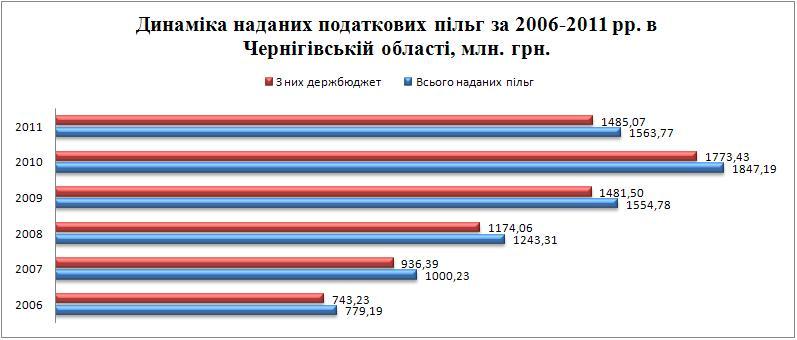
What kinds of activities have eaten a considerable amount of public funds? (Fig. 2).
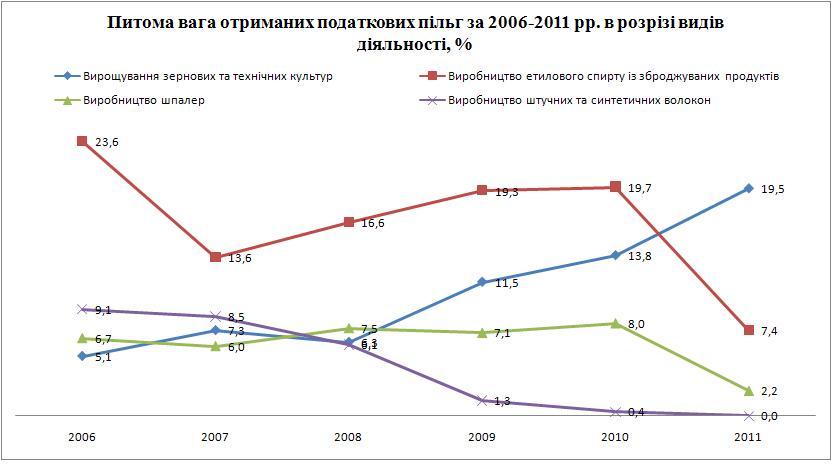
In 2006, the highest proportion of tax benefits granted for ethyl alcohol from fermented products (23.6% or UAH 183.6 million) was obtained in 2006, however, this trend was not preserved during the next 2007 and the amount of tax benefits obtained decreased by UAH 47.6 million. (or by 10%). During 2008-2010, this amount increased by average by UAH 287.4 million. (or by 2.3 %). However, in 2011, there was a known decrease by UAH 248.2 million. (or by 12.3%).
A significant amount of public funds is taken away by the following activities:
-production of cereals and industrial crops (10%);
-production of wallpaper (7%);
-production of artificial and synthetic fibers (5%).
In 2006, the amount of tax benefits obtained for the production of cereals and industrial crops amounted to UAH 39.9 million. (The share of the total amount was 5.1%), with each subsequent year the share and the amount of benefits obtained increased and put: in 2007 UAH 73.5 million. (7.4%), in 2008 – UAH 78.7 million. (6.3%), in 2009 – UAH 17.9 million. (11.5%), in 2010 – UAH 254.7 million. (13.8%) and in 2011 – UAH 305.3 million. (19.5%). That is, the average growth rate for 2006-2011 was about 50% each year. The amounts of tax benefits received for this type of activity are increasing within 5 years.
The production of wallpaper is the third place in terms of weight among all activities that received tax benefits. However, the trend is not unambiguous, so in 2006 the amount of tax benefits amounted to UAH 52.2 million. (6.7%), in 2007 – UAH 60.1 million. (6%), in 2008 – UAH 93.8 million. (7.6%), in 2009 – UAH 111.2 million. (7.2%), in 2010 – UAH 146.9 million. (8 %), in 2011 – UAH 34.0 million. (2.2%).
The production of artificial and synthetic fibers ate an average of 5% of budget funds in the form of tax benefits obtained. At the same time, for 5 years there is a tendency to reduce the benefits provided in this type of activity.
Production of cereals and industrial crops, production of ethyl alcohol, wallpaper production and production of artificial and synthetic fibers occupy almost 50% of all activities that will receive tax benefits. Currently, no facts have been found experts from the Polissya Fund, which indicated violations of the norms and principles of fair application of the latter relative to individual enterprises of the region.
At the same time, it should be noted that gathering information on forms and volumes of state aid to enterprises in the territory of Chernihiv region is sufficiently complicated due to the lack of a suitable body in the region that would process such information.
The Polissya Fund in the future intends to continue monitoring the issues of providing state aid to certain economic entities in order to ensure the transparency and legality of this process, as well as to adapt EU standards.